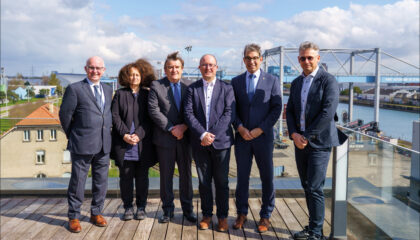
On 26 March, the Port of Strasbourg hosted the official presentation of HySyn – Hydrogen Synergies, a strategic cross‑border cooperation project aimed at developing the green hydrogen value chain in the Upper Rhine area.
Funded under the Interreg Upper Rhine | Rhin Supérieur programme, HySyn brings together 26 partners from France, Germany and Switzerland. The project addresses shared territorial challenges by contributing to the green and low‑carbon transition, accelerating the decarbonisation of industrial activities, strengthening the competitiveness of the cross‑border economic area, and positioning the Upper Rhine as a European pilot region for low‑carbon hydrogen.
Project Scope and Strategic Orientation
HySyn (Hydrogen Synergies) is a cross‑border cooperation project led by the Chamber of Commerce and Industry Grand Est (CCI Grand Est) within the framework of the Interreg VI A Upper Rhine programme. Its objective is to establish an integrated and resilient industrial value chain for green and low‑carbon hydrogen across the trinational Upper Rhine area (France – Germany – Switzerland).
The project aims to strengthen the Upper Rhine as a strategic innovation and industrial area, generating clear European added value through cooperation and contributing to the implementation of Interreg programme priorities related to innovation, energy transition and sustainable economic development.
Strategic Challenges: Industrial Sovereignty, Competitiveness and Energy Transition
Green hydrogen is recognised as a key enabling technology for the energy transition, particularly for the decarbonisation of energy‑intensive industries, logistics, heavy mobility and energy systems.
HySyn contributes to reinforcing European industrial sovereignty by structuring hydrogen value chains at an early stage and reducing dependence on non‑European technologies. By fostering cooperation between economic actors, research institutions and public authorities, the project supports the reindustrialisation of the Upper Rhine area, safeguards industrial employment and strengthens the long‑term competitiveness of the cross‑border territory.
The Upper Rhine Area as a Pilot Region
The Upper Rhine area benefits from particularly favourable conditions for the development of a hydrogen economy:
- a central location at the heart of industrial Europe;
- a strong and diversified industrial base;
- major port and logistics infrastructures;
- well‑established research, innovation and training ecosystems;
- a long‑standing culture of cross‑border cooperation.
HySyn builds on these assets to overcome common challenges such as lack of scale, fragmentation of pilot initiatives, high investment costs and insufficient hydrogen infrastructure. The Upper Rhine is conceived as a living lab, enabling testing, implementation and scaling‑up of innovative hydrogen solutions.
Objectives and Added Value of Cross Border Cooperation
An Integrated Hydrogen Value Chain
HySyn addresses the entire hydrogen value chain:
- production,
- storage,
- transport and infrastructure,
- industrial technologies and equipment,
- industrial applications and heavy mobility.
Operational Objectives
The project aims to:
- map existing skills, technologies and capacities in the Upper Rhine area;
- strengthen networking between companies, research organisations and public authorities;
- support pilot projects and industrial demonstrators;
- foster innovation, skills development and employment;
- contribute to the emergence of a functional and attractive cross‑border hydrogen market.
Structuring Cross Border Partnership
HySyn is implemented by a partnership of 26 organisations from the three countries of the Upper Rhine, including chambers of commerce, regional and local authorities, industrial clusters, universities, research institutes and logistics stakeholders.
This partnership creates tangible added value through cross‑border cooperation by:
- pooling resources and expertise,
- enabling economies of scale,
- jointly anticipating industrial and public needs,
enhancing the international visibility of the Upper Rhine as an innovation ecosystem for hydrogen technologies.
Role and Added Value of the Port of Strasbourg
The Port of Strasbourg is a key project partner and contributes its expertise in three main areas:
- Studies and strategic planning: analysis of hydrogen production potential, demand, cross‑border flows and water resources required for electrolysis.
- Territorial and operational implementation: support for local hydrogen ecosystems (notably in Marckolsheim) and benchmarking among Upper Rhine ports regarding hydrogen supply, transport and distribution.
- Capitalisation and knowledge dissemination: development of a digital Hydrogen Port Center, providing methodological tools, thematic workshops and awareness‑raising actions for public authorities and economic stakeholders.
HySyn is a structuring project of the Interreg Upper Rhine programme, contributing to the transformation of the Upper Rhine from a simple energy transit area into a shared European space for innovation, production and value creation in green hydrogen.
By combining cross‑border cooperation, industrial structuring and European ambition, the project simultaneously addresses the challenges of the energy transition, reindustrialisation and long‑term strategic competitiveness.